

ROLLY DANCE OPEN is an open dance festival, where dancers from different clubs and schools can participate, regardless of their affiliation with national or international dance associations. Everybody is welcome at ROLLY DANCE OPEN.
Date : November 2020
Place (Hall): Tabor Hall (Dvorana Tabor), Koresova ulica 7, Maribor, Slovenija
Organizers: ŠPORTNA POMLAD, Plesna šola Rolly, ŠD Rolly, Zveza društev Saltare, Plesni klub Rogatec, Plesni klub Šmarje pri Jelšah, DPD Rolly Rogaška, KUD Rolly, Promessa so.p.
Registration deadline: April 4, 2020
Registration and information:
- website: https://rolly.si/open/
- E-mail: rolly.open@gmail.com
- Tel: +386 41 704 517 – Branko, +386 41 852 707 – office ROLLY DANCE OPEN”
- Registration: click tab “Registration
Rolly Dance Open 2020 – Flayer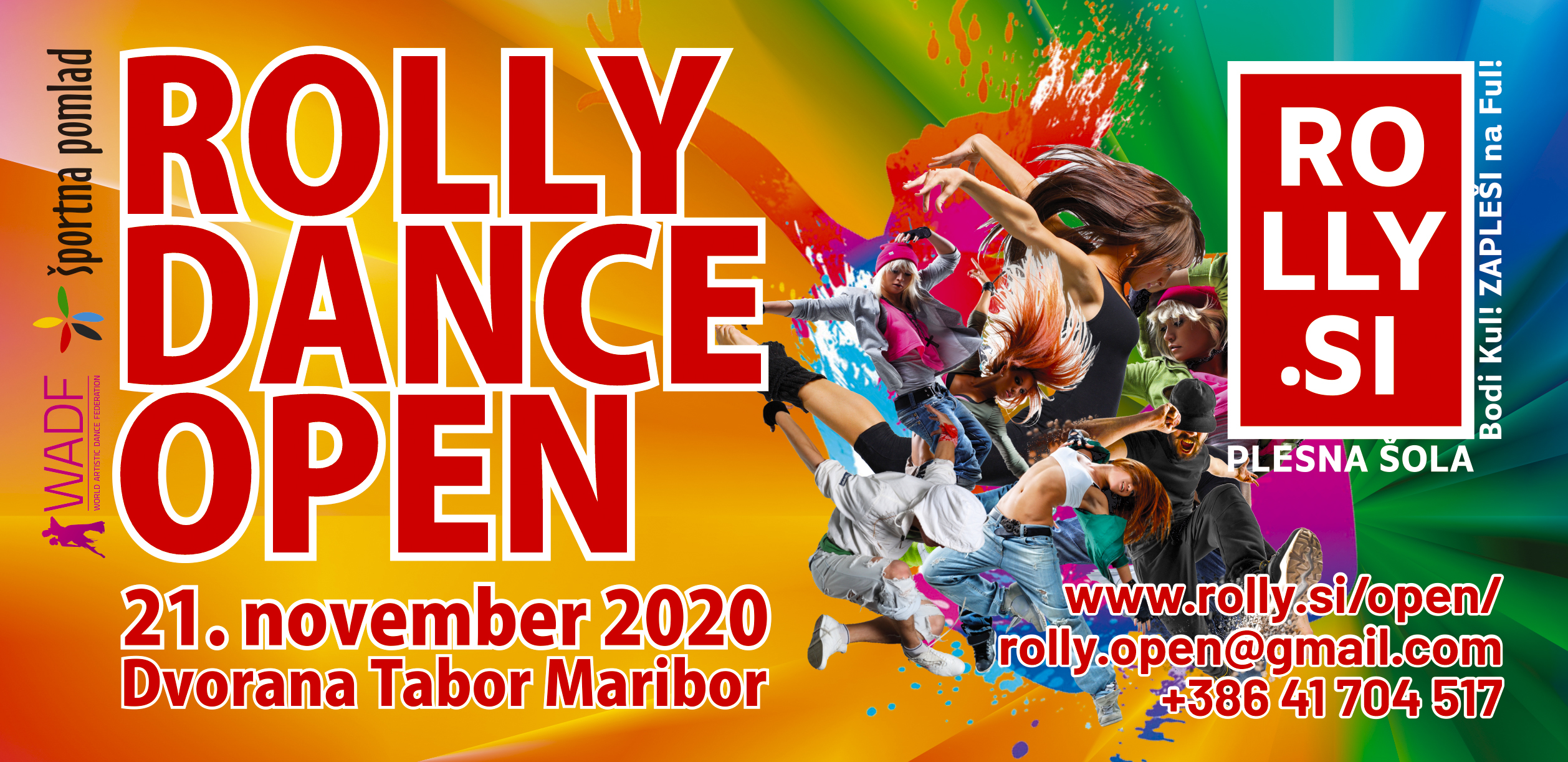
Rolly Dance Open 2019 – THE RESULTS!
ROLLY DANCE OPEN is an open dance festival, where dancers from different clubs and schools can participate, regardless of their affiliation with national or international dance associations. Everybody is welcome at ROLLY DANCE OPEN.

DANCE DISCIPLINES
- URBAN (Urban encompasses choreographies of different street dance styles, such as hip hop, disco dance, break dance, electric boogie etc. It could be only technical choreograph or it could be integrated into a story. Stage props are permitted).
- DISCO DANCE (Disco dance contains disco genres such as dance floor and freestyle. Modern elements from hip-hop and break dance etc. are allowed, but typical disco elements should dominate. Acrobatic moves are allowed but should not dominate the performance).
- ACROBATIC DANCE (Acrobatic dance is a dance style that combines classical dance technique with precise performance of acrobatic elements. Its choreography should seamlessly blend dance and acrobatics. Acrobatics must be a part of the dance and not a gymnastic floor exercise).
- BREAK DANCE BATTLE (Break dance constitutes of: footwork (Six-step, Knee-step…), Up rock (Battle-rock, Indian-step…), freezes (Clash, Baby-freeze…), power moves (Headspin, Windmills…). Acrobatic moves (Flips/Screws, Butterflies) are allowed, but should not dominate the performance).
- HIP HOP BATTLE (Different styles of hip hop, such as old-school (popping, locking, jazz-rock, hype…), new school (new style, krumpin, dance hall…), housedance (footwork, jacking, lofting), wacking, voguing, fall under hip hop discipline. Movements and elements, typical of electric boogie and break dance, are allowed, but should not dominate the performance).
- SHOW DANCE (Show dance is based on jazz technique, classical ballet technique and moderncontemporary dance technique. Technique of other dance disciplines can be incorporated, but should not dominate the performance. Story, presented by dancers, is the essential component of individual performances).
- JAZZ (Jazz is an extremely diverse art form. The entire routine must consist of jazz work, i.e. jazz technique turns, jumps isolations, stretch etc. Acrobatic elements are not permitted. Choreography must consist of basic jazz elements).
- MODERN (Modern dance is based on a relaxed, free movement-dancing, choreographers use feelings and moods to design their own dance steps. The entire dance routine must consist of modern dance techniques and current trends).
- BALET (Dancers in this discipline must present Classical Ballet Technique and style and must perform it in soft ballet slippers or Pointe shoes. Lyrical, modern and modern jazz techniques and pieces are not permitted in this discipline).
- TEP (The primary emphasis is on the harmonious bled of the music and dancer’s footwork technique; the dancer uses taps on his/her shoes to make sounds. The music must not contain pre-recorded taps. The dancer’s taps and music must be clearly audible to the dancer him/herself, to the audience and to adjudicators/judges).
- ORIENTAL (This style of dance is based on classical RagsSharqi style and can contain elements of other oriental folk dances and styles).
- FOLK AND ETHNIC DANCE (This style of dance must express regional tradition, passed down from generation to generation. Costumes and music must reflect folkloric tradition).
- MAJORETTE & TWIRLNIG DANCE (The main prop or accessory in majorette dance is the baton. There are also additional accessories, such as flags, ribbons, pom-poms, umbrellas, hats … Besides marching the dance incorporates also basics of ballet technique, gymnastics and dance to different music while performing demanding elements with baton and other accessories).
- POM PON (Incorporated intensive physical activity both to motivate sport teams and audiences and for fun. Choreography can encompass many elements, such as tumbling, jumping, cheering in order to motivate spectators to cheer for a sports team).
- LATINO SHOW
- TANGO
- PRODUKCIJE (A production is defined as an elaborate theatrical presentation. It must contain a clear theme and story with a beginning, middle and end. Its primary purpose is audience entertainment. All dance styles are allowed. There are no age restrictions in productions and dancers from different age divisions can compete).
AGE DIVISIONS
A dancer’s age division is determined by his or her year of birth as it falls within the calendar year of the competition.:
- MINI: 4-7 years (year of birth: 2016 – 2013)
- CHILDREN: 8-11 years (year of birth: 2012 – 2009)
- JUNIOR: 12-15 years (year of birth: 2008 – 2005)
- ADULT: 16-34 years (year of birth: 2004 – 1986)
- SENIOR: + 35 years (year of birth: 1985…)
In duo/trio, group and formation categories the eldest dancer’s date of birth determines the age division. Younger dancers than determined for a particular Age Division can dance in each Age Division, under the condition that they are no more than two years younger than the lower age limit of Age Division in which they are dancing. This rule applies to all Age Divisions, except for Productions. Specific exemptions are allowed in agreement with the organizer. Productions are groups where dancers of all Age Divisions can dance without limitations.
PERFORMANCE AND TIME LIMITS
There is a maximum of 30 seconds allowed for scenic set up for each performance. Dancers themselves, with the exception of dancers from the MINI category, must set up the scene. Dancers also have 30 seconds to break down the scene after the performance and to leave the dance floor clean and intact. Any damage, done to the dance floor/stage as a consequence of performance or movement of scenic props is the responsibility of the club/school.
- SOLO: 1 (1:00 – 2:15)
- DUO/TRIO: 2-3 (1:00 – 2:15)
- GROUP: 4-10 (2:00 – 3:00)
- FORMATION: 11-30 (2:00 – 4:00)
- PRODUCTION: +31 (3:00 – 5:00)
Music, exceeding the allotted time, will be muted at the upper time limit. A margin of +/- 2 seconds is allowed.
MUSIC
The music should be appropriate according to the appearance and age of the competitors. Music in categories MINI, CHILDREN and YOUNG should not include offensive and vulgar expressions.
You can upload music after registering on the festis app. We recommend that you have a copy of the music on the contest also on the USB stick.
CANCELLATION
CANCELLATION Registration cancellation is not possible after the registration deadline, except when the cause for the cancellation l is a medical condition (disease, injury etc.) and the Participant submits to the Organizer a physician’s note about said medical condition. Only in such a case the already paid entry fee will be refunded as follows:
|
|
|
|
|
Za zagotovilo vračila že vplačane štartnine je potrebno organizatorju predložiti dokumente, ki izkazujejo razlog odjave. V nasprotnem primeru vračilo ni možno.
RULES
Registration deadline is April 30, 2020!
ROLLY DANCE OPEN is an open dance festival, where dancers from different clubs and schools can participate, regardless of their affiliation with national or international dance associations. Everybody is welcome at ROLLY DANCE OPEN dance festival.
ENTRY FEES AND PAYMENT
Registratiron on festis.
JUDGES AND JUDGING


SYSTEM OF COMPETITION
Each category is judged by 5 judges.
Judges evaluate each routine using points from 1 – worst to 10 – best in the following parameters:
– TECHNIQUE (balance, poise, smoothness of movement, agility, body control, body stretch, body strength, power, use of shape and lines)
– MUSIC, RHYTHM (musical timing, musical phrasing, appropriate music, diversity of rhythm)
– INTERPRETATION (presentation, personality, emotional execution, energy, charisma, self-assuredness, interaction between dancers)
– CHOREOGRAPHY (creativity, originality, use of space/dimensions/levels, theatrical and visual effects, synchronization)
– OVERALL IMPRESSION (appropriate costume and make up, grooming, ability to capture the audience, crowd appearance, would you like to see it again)
The final result is the arithmetic mean of the scores that have been assigned by all the judges, where the best and worst scores for each evaluated parameter have been discarded.
The winner in each category is the routine that has been evaluated with the highest number of points. If two or more routines reach the same number of points, the winner is the routine that has the highest number of points in the technique parameter. If it is not possible to determine the winner even after that, the deciding factor become the highest number of points in parameter music, rhythm, then interpretation, choreography and lastly also overall impresion. If after the mentioned order of parameters it is still not possible to determine a winner, best routines share the first place.
Judges can also provide comments for each routine. Comments are anonymously presented at FestIS web application after each festival. Dance club/school can see only comments for their routines.
OUR PARTNERS:
 TABLE OF SCORES:
EXCEPTIONS:
HIP HOP OPEN SOLO BATTLE The competitors dance to the music of the Organizer’s choice. In the Preliminary rounds dancers dance in groups, formed in a circle, and take turns dancing in the middle of the circle. Judges then select top 16 dancers and award them cards that guarantee the dancers qualify for one on one battles. The Preliminary rounds are complete when Judges award all 16 cards. After the completion of Preliminary rounds, the chosen 16 dancers will be randomly paired together for one on one battles. Each dancer in the pair will have two rounds – lasting a maximum of 1 minute each – to dance, the dancer starting both rounds is randomly selected at the beginning of the battle. The Competition starts with eighth-finals. In semi-finals the remaining 2 pairs of dancers compete in one on one battles. The losers of semi-finals then compete against each other in a one on one battle for the 3rd place and the winners of semi-finals compete against each other in a one on one battle for the 1st place.
BREAK DANCE OPEN SOLO BATTLE The competitors dance to the music of the Organizer’s choice. In the Preliminary rounds dancers dance in groups, formed in a circle, and take turns dancing in the middle of the circle. Judges then select top 16 dancers and award them cards that guarantee the dancers qualify for one on one battles. The Preliminary rounds are complete when Judges award all 16 cards. After the completion of Preliminary rounds, the chosen 16 dancers will be randomly paired together for one on one battles. Each dancer in the pair will have two rounds – lasting a maximum of 1 minute each – to dance, the dancer starting both rounds is randomly selected at the beginning of the battle. The Competition starts with eighth-finals. In semi-finals the remaining 2 pairs of dancers compete in one on one battles. The losers of semi-finals then compete against each other in a one on one battle for the 3rd place and the winners of semi-finals compete against each other in a one on one battle for the 1st place.
GENERAL PROVISIONS
The dance floor measures a minimum of 15 x 12 meters. The club/school representative collects tickets and start numbers for the competitors. The representative also submits music for the performances. Only dancers who have completed the entry fee payment till deadline can compete in the festival. Participants must abide by festival rules and regulations and compete at their own risk. The Organizer does not take any responsibility in the event of possible injury, especially not financial or any other liabilities to third parties for the duration of the festival. Participants must be responsible for the safekeeping of their own personal items, for they are not the Organizer’s responsibility. The participants of the festival authorize the use of photos and videos of themselves for the purpose of promoting the festival and waive any and all rights in this respect. The winner of the MASTER DANCE GALA EVENING receives a grand prix transitional trophy, which they must return to the Organizer no later than by the beginning of the next year’s festival. By registering and paying the entry fee each participant unconditionally accepts all of the listed rules and regulations of the festival.
The competitors dance to the music of the Organizer’s choice. In the Preliminary rounds dancers dance in groups, formed in a circle, and take turns dancing in the middle of the circle. Judges then select top 16 dancers and award them cards that guarantee the dancers qualify for one on one battles. The Preliminary rounds are complete when Judges award all 16 cards. After the completion of Preliminary rounds, the chosen 16 dancers will be randomly paired together for one on one battles. Each dancer in the pair will have two rounds – lasting a maximum of 1 minute each – to dance, the dancer starting both rounds is randomly selected at the beginning of the battle. The Competition starts with eighth-finals. In semi-finals the remaining 2 pairs of dancers compete in one on one battles. The losers of semi-finals then compete against each other in a one on one battle for the 3rd place and the winners of semi-finals compete against each other in a one on one battle for the 1st place.
1st place – 50 % of prize fund
2nd place – 30 % of prize fund
3rd place – 20 % of prize fund
4th place – practical gift
Coming soon
Soon
6 70 708 808!
Coming soon
ROLLY DANCE OPEN will take place in Tabor Hall Maribor.
E-mail: rolly.open@gmail.com
Tel: +386 41 704 517 – Branko, +386 41 852 707 – office ROLLY DANCE OPEN
